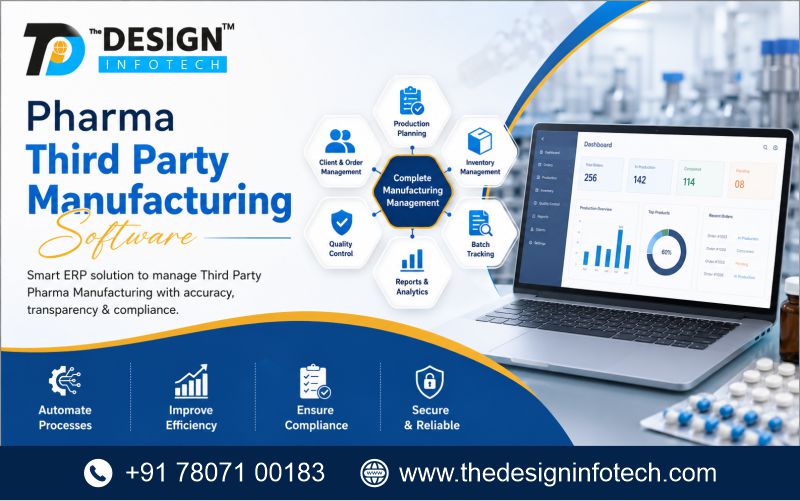
Pharma Third Party Manufacturing Software

Pharma Third Party Manufacturing Software

📞 Enquire Us Now
Pharma manufacturing is entering an era of massive digital transformation. It is predicted that in recent times the pharmaceutical manufacturing software market is predicted to be worth $8.92 billion by 2030 from $2.25 million in 2023 with an annual growth rate of 11.3% from 2023-2030. For contract manufacturers and third party pharma manufacturing operations, embracing 3rd party pharmaceutical manufacturing software solutions is vital to stay complaint, enhance operational performance and growth.

An ERP for pharmaceutical manufacturing operators gives integrated functionalities to oversee and integrate operations starting from procurement of materials until the distribution.

For contract pharma, an ERP for 3rd party manufacturing offers much needed insights into issues faced like multi-customer jobscheduling, quality analysis, material control and compliance. Read how pharma third party manufacturing software redefines the workflow in this contract manufacturing ecosystem.

Why Pharma Third Party Manufacturing Software is Critical in 2026

Increased Reliance on Contract Manufacturing

The sector of contract pharmaceutical manufacturing has seen tremendous growth. As of 2025-2026 figures, approximately 35% of pharmaceutical products are manufactured by contract manufacturers across the world. As the global contract manufacturing organization (CMO) market reached $7.2 billion in 2024, it’s estimated to grow 10.8% per year until 2032.
Contract manufacturing is complex in pharma. Third-party pharma manufacturing facilities have complex processes such as the creation of capsules, tablets, injections, syrups and other specialized medications. It becomes complicated to deal with several clients, numerous batches, quality expectations and regulatory standards without a suitable pharma third party manufacturing software.

Pharma Third Party Manufacturing Software
📞 Enquire Us Now
Principal Difficulties in the Absence of Appropriate ERP Systems

For third-party manufacturers, there are some unique difficulties that they may face:
Navigating Regulatory Compliance: Pharmaceutical manufacturing processes follow international standards which are monitored closely by several regulatory bodies like FDA, WHO, and GMP. ERP for pharma companies helps in automating quality checks and documentation procedures.
Multi-client production scheduling: unlike in-house manufacturing units, third party manufacturers handle multiple client requirements concurrently. The pharma third party manufacturing software helps in optimally scheduling batch production to utilize its entire resources and fulfill the client’s delivery timelines.


Quality control for multiple products: maintaining quality standards is more complex for multi-product manufacturing with varying specifications, as demanded by each client. ERP for a pharmaceutical manufacturer helps in real-time tracking of all quality control parameters.
Maintaining Cost Effectiveness and Profitability: contract manufacturing involves tight profit margins. Appropriate software will reduce waste, improve resource utilization and enhance tracking of overall profitability.
Transparency and batch management: regulatory authorities demand complete traceability of drugs. Robust pharma third party manufacturing software provides complete visibility to batch production and supply chain.

Core Features of Effective Pharma Third Party Manufacturing Software

1. Production Planning and Scheduling

Top ERP for third party pharma manufacturing has AI based scheduling that takes into account:

  • Client-specific delivery requirements
  • Equipment availability and capacity
  • Material procurement timelines
  • Quality testing schedules
  • Staff allocation and expertise

2. Inventory and Supply Chain Management

An ERP for pharmaceutical manufacturer tracks:

  • Raw material procurement and storage
  • Work-in-progress (WIP) inventory
  • Finished goods management
  • Track expiry date (just as for medicines)
  • Supplier performance metrics
  • Automated reordering based on thresholds

3. Quality Management System (QMS)

Pharma third party manufacturing software includes:

  • Standard operating procedure (SOP) management
  • In-process quality checks
  • Batch record documentation
  • Non-conformance tracking
  • Deviation management
  • Certificate of Analysis (CoA) generation

4. Batch and Serial Number Tracking

Complete traceability through:

  • Unique batch identification
  • Component-level tracking
  • Serial number assignment
  • Lot number management
  • Recall capability within minutes

5. Regulatory Compliance and Documentation

An ERP for pharmaceutical manufacturers automates:

  • Validation protocols (IQ, OQ, PQ)
  • Change management records
  • Audit trail maintenance
  • 21 CFR Part 11 e-signature complianc
  • Regulatory report generation

6. Financial Management and Costing

Specialized modules track:

  • Job costing per batch
  • Manufacturing overhead allocation
  • Margin analysis by client
  • Pricing optimization
  • Profitability reporting

Pharma Third Party Manufacturing Software
📞 Enquire Us Now
Current Market Statistics and Industry Trends (2025-2026)

Market Size and Adoption Rates: 

  • Market Size – $6.8 billion in 2024 Market size share of Contract Manufacturing 28% 
  • Adoption – 64% (mid/large pharma manufactures use specialized ERP systems up from 48%) investment Pharma companies increase IT software spend by 23% year-over-year in 2025. 
  • Cloud adoption– 58% new pharma ERP implementations are cloud based (up from 42%) and many on premise implementations are being migrated to cloud based environments. 
  • Contract manufacturing – There are over 2,800 facilities dedicated to contract manufacturing around the world and nearly half of this is Asia/Pacific.

Over 600 sites are located in India, more than any other nation globally, and more than a third of the world’s supply is manufactured in India alone.

Twenty percent (20%) of generic drug supplies and fifteen percent (15%) of proprietary drug production facilities currently utilize third-party manufacturing. 

  • Third party quality and cost – pharma manufacturers are now dedicating between 18 percent and 22 percent of their IT budget to quality and compliance solutions. 
  • Failure to properly digitize is cited as the top cause for failing audits – with 89 percent of audited facility organizations stating this is the primary issue. Companies that implement a third-party quality manufacturing solution decreased audits by nearly 70%.

Benefits for Pharmaceutical Manufacturer’s Implementation – 

Increases In Operational efficiency- 

Process times up by 35% inventory reduced by 42% increased equipment utilization by 28% reduced materials waste by 19% Quality and compliance quality first time pass rates up 99.2% reduced audit results down to 2% time faster approval time for regulated drugs 2x quicker traceability Complete record keeping in under two minutes The following financial increases will result: Twenty-two percent (22%) increase in overall profit A 31% increase in invoice processing times The capital requirement has dropped by twenty six percent (26%). This is reflected as an eighty seven percent (87%) fewer cost errors for job costing for quotations

Choosing the Right Pharma Third Party Manufacturing Software

Selecting Critical Factors 

  1. Industry Specialty 

Your ERP should be specialized to pharmaceuticals; not general manufacturing capabilities.

  1. Regulatory Ready 

Your solution comes pre-configured with compliance and approval structures like FDA, GMP, or WHO?

3. Future Ready ERP 

The ERP technology architecture should scale easily. You’ll avoid costly re-engineering later if you future-proof your investment. 

  1. Interoperability 

All of your existing applications, as well as client-facing tools that access the ERP should integrate smoothly. 

  1. Vendor’s Pharma Expertise and Service 

Learn from a vendor that understands nuances like drug development process. Assess their customer support capabilities.

  1. Lifetime Costs 

Take into account initial purchase price, licensing, implementation, customizations, upgrades and ongoing support fees.

  1. End User Friendliness (EUX) 

Take a test drive of system performance under real load. If an ERP is complicated, the user adoption rate is extremely low.


Implementation Best Practices

Phase 1: Planning and Assessment (6–8 weeks)

  • Current state analysis 
  • Requirements definition 
  • Vendor assessment and negotiation 
  • Project team readiness and training strategy 

Phase 2: Configuration and Customization (8–12 weeks) 

  • System setup and configuration 
  • Data migration approach 
  • Development of integrations 
  • User Acceptance Testing (UAT) Phase 

3: Go Live and Stabilization (4–6 weeks) 

  • Production 
  • Go Live Post go live hypercare system support 
  • Performance analysis and optimization Phase

4: Optimization and Ongoing Enhancements 

  • Ongoing system performance analysis 
  • Integration of ongoing user feedback 
  • System updates 
  • Compliance monitoring

Future Trends in Pharma Third Party Manufacturing Software

AI Features: The rise of AI enabled demand forecasting and predictive maintenance are now an increasingly standard ERP capability in third party pharma manufacturing processes. Traceability enhancements: Blockchain is being looked to for greater supply chain visibility, as well as to reduce and identify counterfeit products. 

Real Time Analytics: Pharma third party manufacturers are more frequently demanding the ability to be delivered real-time dashboards, as well as make real time predictions based on this data.

RPA (Robotic Process Automation); It’s possible now for more of the manual compliance work and basic data inputting work of a contract pharmaceutical process to be performed by RPA.

Tracking Environmental Impact; We are seeing carbon footprint calculators & environmental reporting, becoming a more standard component of pharmaceutical software for third party contract manufacturers.

Pharma Third Party Manufacturing Software
FAQs on Pharma Third Party Manufacturing Software

1. How does pharma third party manufacturing software ensure regulatory compliance?

Pharma third party manufacturing software ensures regulatory compliance through various features such as pre-configured GMP requirements, automated audit trails, electronic signature functionality (compliant with 21 CFR Part 11), and batch record validation. All quality parameters, deviations, and corrective and preventative actions (CAPAs) are automatically tracked by the system. Regulatory reports can be prepared quickly, dramatically shortening the time needed for audits and regulatory inspections, typically moving reporting from several days to minutes. Most ERP for pharmaceutical manufacturers are built with compliance templates for both U.S. FDA and international (EU, WHO) guidelines.

2. What is the typical ROI timeline for implementing an ERP for pharmaceutical manufacturers?

Most facilities implementing an ERP for pharma company achieve a positive return on investment (ROI) in an average of 18-24 months. Quick wins achieved during this period often include significantly reduced inventory costs (3-6 months), improved production efficiency (6-9 months), and lower compliance-related costs. A typical ROI calculation for ERP for pharmaceutical contract manufacturers considers factors such as labor savings, reduced waste and spoilage, better capacity utilization, and lower costs associated with audit findings. Larger facilities, particularly those producing batches for many different clients, typically see a faster ROI due to their higher operational complexity.

3. Can pharma third party manufacturing software integrate with client systems?

Yes, the modern pharma third party manufacturing software offers multiple methods of integration to connect with customer systems, including API, EDI (Electronic Data Interchange), and cloud-based data exchange. This allows for seamless data synchronization for orders, quality standards, and delivery timelines. Integration with client systems reduces manual data entry, improves accuracy, enhances communication, and can speed up the order fulfillment process. Many ERP vendors provide out-of-the-box connectors for popular ERP systems such as SAP, Oracle, and NetSuite.

4. How does an ERP for pharmaceutical manufacturers handle multi-client batch production?

An ERP for pharmaceutical contract manufacturers has sophisticated capabilities for handling multi-client batch production. This includes specialized job-based costing, separate batch numbering for each client, client-specific quality control parameters and tests, dedicated traceability documentation for each client, and segregated inventory tracking. These systems prevent accidental commingling of products while optimizing the utilization of equipment for all clients. Production planning is also highly flexible and capable of balancing the priorities of various clients against facility capacity constraints.

5. What security measures protect data in pharma third party manufacturing software?

The security features of a pharmaceutical-grade ERP are paramount. Standard security practices include enterprise-grade Role-Based Access Control (RBAC), comprehensive encryption for data at rest and in transit, rigorous and regular security audits, adherence to data privacy regulations (e.g., HIPAA, GDPR), automated backup procedures, disaster recovery planning, and meticulous audit logging of all system activities. Multi-factor authentication (MFA) is a common user access control, and all data changes are logged in immutable audit trails for regulatory purposes.

6. How long does implementation of an ERP for pharma company typically take?

The timeline for implementing pharma third party manufacturing software varies but generally falls within 16-32 weeks. This timeframe depends on the complexity of the manufacturing facility, whether significant customization of the system is required, and the extent of data migration needed. Smaller facilities with straightforward requirements may be able to implement in as little as 4-6 months, while larger, multi-site organizations might need 8-12 months for the entire process. Careful pre-implementation planning, team preparation, and vendor selection can add 2-3 months to the total duration.

7. What training and support do vendors provide for pharma third party manufacturing software?

Reputable vendors for ERP for pharmaceutical manufacturers provide extensive training and support. This often includes administrator and end-user training sessions, programs for designated “super users”, a comprehensive library of user guides and video tutorials, and readily available technical support. Many vendors offer 24/7 support during crucial implementation phases and go above and beyond with hypercare and post-go-live support. Additionally, many offer industry expertise, best practice consulting, and quarterly business reviews to ensure continuous optimization and maximum return on the investment in the ERP system and pharma manufacturing efficiency.

Conclusion

Pharma third party manufacturing software has truly transitioned from a nice-to-have tool to a necessity in the business world. A pharmaceutical manufacturers’ ERP considers the complexities of contract manufacturing and helps improve compliance, operational efficiency, and profitability. At The Design Infotech, we provide advanced ERP solutions for the pharmaceutical industry that help manufacturers streamline operations, maintain regulatory compliance, and achieve sustainable business growth.


An organization that integrates pharmaceutical third party manufacturing software now has a business system that provides much added value over its competitors as the sector grows by more than 10% annually. By choosing appropriate software for the pharmaceutical industry and implementing it properly, you’ll begin to see significant improvements in quality, compliance, and bottom-line profits. It’s a strategic decision to invest in an ERP that is right for third party pharma manufacturing while following global regulatory guidelines such as the U.S. Food and Drug Administration (FDA).

Digital Marketing Agency In Panchkula

The digital horizon of North India is shifting. While Chandigarh has long been the face of the Tricity’s commercial success, Panchkula has quietly transformed into a high-octane hub for digital innovation. For business owners today, the question is no longer whether you need a digital presence, but how you can dominate the search results in an increasingly crowded marketplace.

If you are searching for a digital marketing agency in Panchkula, you are likely at a crossroads. You might be a local startup looking to make your first mark, or an established enterprise aiming to scale globally. This exhaustive 1,500+ word blueprint will dive deep into the mechanics of the Panchkula digital landscape, the essential services that drive ROI, and how to choose a partner that doesn’t just “manage” your brand but “multiplies” your revenue.

1. Why Panchkula is the Emerging Powerhouse for Digital Growth

Panchkula, often referred to as the planned city of Haryana, offers a unique business environment that differs significantly from its neighbors, Mohali and Chandigarh. The city has seen a massive influx of boutique agencies and tech startups, particularly in Sectors 11, 5, and the Industrial Area Phases.

The Advantage of Localized Strategy

Choosing a digital marketing company in Panchkula provides you with “Ground-Level Intelligence.” Unlike agencies in distant metros like Delhi or Bangalore, a Panchkula-based team understands the specific nuances of the Haryanvi and Punjabi consumer psyche. They understand the seasonal shopping trends at local hubs like Sector 11 Market or the impact of regional events on consumer spending. This local empathy, combined with global technical standards, creates a potent marketing mix that is difficult to replicate from afar.

2. Core Pillars of an Elite Digital Marketing Agency

A top-tier agency doesn’t just offer services; they offer solutions. To be the best in Panchkula, an agency must excel in four critical pillars that form the foundation of any successful online campaign.

A. Results-Oriented Search Engine Optimization (SEO)

SEO is the art and science of making your business “findable.” In 2026, SEO has moved beyond simple keywords. The best agencies in Panchkula now focus on:

  • Topical Authority: Establishing your website as the go-to resource in your niche to satisfy Google’s E-E-A-T (Experience, Expertise, Authoritativeness, Trustworthiness) guidelines.
  • Technical Resilience: Ensuring your site passes all “Core Web Vitals” with flying colors, providing a lightning-fast experience for mobile users.
  • Semantic Search Optimization: Crafting content that answers the “intent” behind a search, not just the words used.

B. Precision Pay-Per-Click (PPC) Management

While SEO is a marathon, PPC is a sprint. A professional agency uses data to ensure your ad spend isn’t wasted. This involves:

  • Hyper-Targeted Demographics: Narrowing down your audience by age, location, interests, and even recent search behavior.
  • Conversion Rate Optimization (CRO): Optimizing landing pages so that a click actually turns into a phone call or a purchase.
  • Remarketing Loops: Staying “top of mind” by showing ads to users who have previously visited your site but didn’t convert.

C. Social Media Brand Building

Social media in the Tricity is about community and social proof. Agencies in Panchkula leverage platforms like Instagram and LinkedIn to turn CEOs into thought leaders and brands into relatable personalities. This includes high-quality Reel production, interactive storytelling, and community management.

D. Strategic Content Marketing

Content is the currency of the internet. From blogs that solve customer pain points to whitepapers that establish authority, the best digital marketing agencies in Panchkula produce content that serves a dual purpose: pleasing the search engine algorithms and providing genuine value to the reader.

3. The 2026 Digital Shift: AI, Voice, and the New Search

The digital world has changed more in the last two years than in the previous ten. To stay relevant, Panchkula businesses must adapt to these emerging trends that are now being prioritized by leading agencies:

Search Generative Experience (SGE)

Google’s AI-driven search results mean your content must be structured to be “citable” by AI. The agencies that rank highest are those that use advanced Schema Markup and clear, data-backed writing that AI can easily parse and credit as an authoritative source.

Voice and Conversational AI

With the prevalence of smart speakers in Indian households, search queries are becoming longer and more conversational. Instead of “dentist Panchkula,” users are asking, “Siri, find me the best pediatric dentist in Sector 20 Panchkula open now.” Elite agencies optimize for these natural language patterns.

Short-Form Video Dominance

If your marketing mix doesn’t include 60-second vertical videos, you are losing out on over 70% of mobile engagement. Local agencies now maintain in-house studios to produce “snackable” content for YouTube Shorts and Instagram Reels that capture attention in the first 3 seconds.

4. How to Identify a “Growth Partner” vs. a “Service Vendor”

The market is flooded with agencies promising the world. To protect your investment, use this checklist when vetting a digital marketing agency in Panchkula:

  1. Check Their Internal Metrics: If an agency’s own website doesn’t rank for their target keywords, how can they rank yours? Their own digital footprint is their most honest case study.
  2. Ask for Live Dashboards: In 2026, static PDF reports are obsolete. Demand access to live Looker Studio or Google Data Studio dashboards where you can see your data in real-time.
  3. The “Strategy First” Approach: Avoid agencies that offer a “package” immediately. A legitimate partner will first ask about your business goals, your margins, and your customer lifetime value (LTV) before proposing a single tactic.
  4. Local Case Studies: Ask for examples of how they helped a business within the Tricity. Can they show a 200% increase in leads for a local real estate developer or a 50% reduction in CPA for a Panchkula-based e-commerce brand?

5. Why Most Panchkula Businesses Fail Online (and How to Avoid It)

Through our analysis of the local market, we’ve identified three common pitfalls that lead to marketing failure:

  • The “Cheap” Trap: Many business owners opt for the lowest quote. In digital marketing, “cheap” usually means outsourced, automated, or “black-hat” techniques that can result in your domain being blacklisted by Google.
  • Impatient Expectations: SEO takes time. Any agency promising #1 rankings in 30 days is lying. A sustainable, white-hat strategy typically takes 4 to 6 months to show significant ROI.
  • The Disconnected Funnel: Many businesses drive traffic to a website that isn’t built to convert. A top agency will fix your “leaky bucket” (your website UX) before they start pouring water (paid traffic) into it.

6. The Local SEO Advantage: Dominating the “Near Me” Searches

For local businesses in Panchkula—be it a hospital, a law firm, or a luxury showroom—Local SEO is your most powerful tool. This involves more than just a Google Business Profile. It requires:

  • Local Citation Consistency: Ensuring your Name, Address, and Phone number (NAP) are identical across all directories.
  • Review Management: Actively soliciting and responding to Google reviews to build “Digital Trust.”
  • Geographic Content: Writing about local events or issues in Panchkula to signal relevance to local search algorithms.

7. Budgeting for Success: What Should You Invest?

Digital marketing is an investment, not an expense. In the Panchkula market, pricing models generally follow three tiers:

  • The Foundation Tier (Small Business): ₹20,000 – ₹45,000 per month. Best for local visibility and basic social media management.
  • The Scalability Tier (Mid-size): ₹50,000 – ₹1,20,000 per month. Includes aggressive SEO, PPC management, and high-quality content production.
  • The Dominance Tier (Enterprise): ₹1,50,000+ per month. Full-scale omnichannel strategy with dedicated account managers and advanced data analytics.

8. Case Study: Transforming a Panchkula Startup

Imagine a boutique furniture store in the Industrial Area, Phase 1. They struggled with footfall despite having premium products. By partnering with a local agency, they shifted their focus to high-intent “Near Me” SEO and Instagram video tours of their showroom. Within 8 months, their organic leads grew by 450%, and their cost-per-lead dropped from ₹800 to ₹150. This is the tangible power of a localized, data-driven approach.

9. Conclusion: The Roadmap to Future-Proofing Your Brand

Choosing the best digital marketing agency in Panchkula is a decision that will define your business trajectory for the next decade. As the city continues to grow into a technological centerpiece of Haryana, your brand needs a voice that is both loud and clear.

The digital landscape of 2026 rewards authenticity and technical excellence. Don’t settle for a vendor that treats you like a number. Look for a partner that treats your ROI as their own success metric. Take the leap today, audit your current presence, and start building a legacy that survives every algorithm update.

Frequently Asked Questions (FAQs)

Q1: How long does it take to see results from digital marketing in Panchkula? While PPC can generate leads within 48 hours, organic SEO generally requires 4 to 9 months to reach peak performance. Consistency is the key to long-term dominance.

Q2: Should I hire an agency or an in-house person? An in-house person provides focus, but an agency provides a “collective brain.” For the price of one senior employee, an agency gives you access to SEO specialists, graphic designers, copywriters, and ad managers.

Q3: Can I target customers outside of Panchkula? Absolutely. A professional agency can run “Geofencing” campaigns to target users in Chandigarh or Mohali, or even launch international campaigns for e-commerce and IT services.

Q4: What is the most important SEO factor in 2026? User Experience (UX) and Content Depth. Google now prioritizes pages that solve a user’s query comprehensively and provide a seamless, secure browsing experience.

Q5: How do I verify an agency’s claims? Always check third-party review platforms like Clutch.co or Google Business Profile. Reach out to their current clients to get an honest assessment of their reporting and communication styles.

Best Digital Marketing Company In Mohali

In the rapidly evolving business landscape of Punjab, Mohali (SAS Nagar) has emerged as a powerhouse for innovation and entrepreneurship. As more businesses shift from traditional storefronts to digital platforms, the competition to be seen on the first page of Google has never been more intense. If you are a business owner searching for the best digital marketing company in Mohali, you aren’t just looking for a service provider—you are looking for a growth partner that understands the heartbeat of modern commerce.

In this exhaustive 1,500+ word guide, we will break down why digital marketing is the lifeblood of modern business, what specific traits define an elite agency in Mohali, and how the right strategic shift can transform your brand from a local contender into a dominant market leader.

1. Why Mohali is the New Epicentre for Digital Excellence

Mohali is no longer just a satellite town of Chandigarh; it has matured into a thriving IT and commercial hub. With the massive development in QuarkCity, Bestech Business Towers, and specialised IT parks in Sector 67 and 74, the city attracts the brightest minds in technology, AI-driven marketing, and data science.

Choosing a local agency in Mohali offers a unique advantage: Hyper-Local Intelligence. A company based here doesn’t just read data; they live it. They understand the regional consumer behaviour of the Tricity area (Chandigarh, Mohali, Panchkula), the seasonal demand shifts in Punjab, and the exact competitive pressure your business faces daily. This local edge allows them to craft campaigns that resonate emotionally and culturally with your target audience while leveraging global standards of execution.

2. Defining the “Best”: What Sets a Top-Tier Agency Apart?

The term “best” is often thrown around loosely, but in the world of high-stakes performance marketing, it is defined by ROI, transparency, and technical depth. A top-tier digital marketing company in Mohali must offer a holistic ecosystem of services that move the needle beyond “vanity metrics” like likes and followers.

A. Advanced Search Engine Optimisation (SEO)

SEO is the marathon of the digital world. In 2025, it is no longer about keyword stuffing. The best agencies focus on:

  • Topical Authority: Creating deep, cluster-based content that proves your expertise to Google’s E-E-A-T (Experience, Expertise, Authoritativeness, Trustworthiness) standards.
  • Technical SEO: Optimising Core Web Vitals, ensuring sub-second load times, and implementing advanced Schema Markup for rich snippets.
  • Search Generative Experience (SGE) Optimisation: Preparing your content to be cited by AI-driven search results.

B. Precision Pay-Per-Click (PPC) Advertising

While SEO builds long-term equity, PPC delivers immediate cash flow. A professional Mohali agency manages your ad spend using:

  • Conversion Rate Optimisation (CRO): Ensuring that the traffic you pay for actually buys from you.
  • A/B Testing: Constantly iterating on ad copy and landing pages to lower your Cost Per Acquisition (CPA).
  • Multi-Channel Remarketing: Following your potential customers across YouTube, Instagram, and Display networks until they are ready to convert.

C. Social Media Marketing (SMM) & Community Building

In 2026, social media is about “Social Proof” and “Community.” The best agencies don’t just post pictures; they create engaging Reels, host interactive webinars, and manage LinkedIn thought leadership for CEOs. They turn a brand into a personality that people want to interact with.

D. Data-Driven Content Marketing

Content is the fuel for every digital channel. From long-form whitepapers and case studies to viral video scripts, elite agencies produce content that solves problems for the user, naturally leading them down the sales funnel.

3. The 2026 Shift: Emerging Trends Every Mohali Business Must Know

To stay at the top, you cannot use 2020 strategies in 2026. The digital landscape has undergone a tectonic shift. Here is what the best digital marketing companies in Mohali are implementing right now:

Voice and Conversational Search

With the rise of sophisticated voice assistants and AI-driven home devices, search queries have become more conversational. Instead of searching “best gym Mohali,” users are asking, “Where is the best gym near Phase 7 with a personal trainer?” Agencies now optimise for these long-tail, natural language queries.

Short-Form Video Dominance

If your business doesn’t have a video-first strategy, you are invisible to the Gen Z and Millennial demographics. Elite agencies in Mohali now have in-house production teams to create high-octane 60-second vertical videos for Instagram Reels, YouTube Shorts, and TikTok.

AI-Enhanced Personalisation

Using machine learning to deliver a different experience to a first-time visitor versus a returning customer is now the gold standard. This level of personalisation drastically improves customer loyalty and lifetime value.

4. Step-by-Step Checklist: How to Choose Your Partner

With hundreds of agencies in the Tricity area, filtering the “noise” is difficult. Follow this checklist:

  1. Audit Their Own Presence: If a marketing agency’s own website is slow or ranks on page 5 of Google, they cannot help you. Their own digital footprint is their primary resume.
  2. Verify Their Case Studies: Ask for “Before and After” data. Look for specific metrics: “Increased lead volume by 40% while reducing cost-per-lead by 15%.”
  3. The Reporting Structure: Do they send a vague PDF once a month, or do they give you access to a live Looker Studio or Google Data Studio dashboard? Transparency is the hallmark of a professional firm.
  4. Cultural Alignment: Does the team understand your industry? A marketing strategy for a real estate developer in Mohali is worlds apart from a strategy for an e-commerce startup in the fashion niche.

5. Why Businesses in Mohali Fail at Digital Marketing

It’s important to understand the pitfalls that drain marketing budgets with zero results:

  • Chasing Low Prices: The “cheapest” agency often uses automated bots or black-hat SEO tactics that can get your website permanently banned from Google.
  • Lack of Patience: SEO is an investment. Expecting a #1 ranking in 30 days is unrealistic. A legitimate strategy takes 3 to 6 months to mature.
  • No Integrated Funnel: Driving traffic to a broken website is like pouring water into a leaky bucket. The best agencies fix your website’s user experience (UX) before spending a single rupee on ads.

6. The Local Advantage: Why Mohali Agencies are Outperforming Metros

Agencies in Mohali often provide a higher level of “White-Glove” service compared to massive firms in Delhi or Mumbai. Because the community is tightly knit, a Mohali agency’s reputation is its most valuable asset. They are more likely to offer personalised attention, frequent face-to-face meetings, and a deeper commitment to your local success.

Furthermore, the cost of operations in Mohali is slightly lower than in Mumbai or Bangalore, allowing these agencies to pass those savings on to you while still employing top-tier talent from prestigious institutes.

7. Maximising ROI: What Should You Expect to Spend?

Budgeting for digital marketing in Mohali varies based on your goals. However, a general breakdown looks like this:

  • The Growth Phase (Startups): Typically ranges from ₹25,000 to ₹50,000 per month. Focuses on foundational SEO and social media presence.
  • The Aggressive Phase (Mid-size): Ranges from ₹60,000 to ₹1,50,000 per month. Includes heavy PPC spend, video content production, and advanced link-building.
  • The Market Dominance Phase (Enterprise): Upwards of ₹2,00,000 per month. Full-scale omnichannel management with dedicated account managers and data scientists.

8. Case Study: The Impact of a “Local First” Strategy

Consider a local healthcare clinic in Mohali Phase 3B2. By partnering with a local agency, they optimised for “Near Me” searches and created video testimonials of residents. Within six months, their organic patient inquiries increased by 300%. This is the power of combining digital expertise with local cultural context.

9. Conclusion: Your Path to Market Leadership

Finding the best digital marketing company in Mohali is not just about a Google search; it’s about finding a team that views your business goals as their own. In a city that is rapidly becoming the Silicon Valley of North India, your brand deserves a strategy that is as ambitious as your vision.

The digital world doesn’t wait for anyone. While you deliberate, your competitors are likely already optimising their keywords and scaling their ad spend. Take the first step today. Reach out to a professional who offers a data-backed roadmap, and watch your business transform into a revenue-generating powerhouse.

Frequently Asked Questions (FAQs)

Q1: How do I know if an agency in Mohali is legitimate? Check their Google Business Profile reviews, ask for client references, and verify their presence on platforms like GoodFirms or Clutch. A legitimate agency will always be happy to share its success stories.

Q2: Is SEO still relevant with the rise of AI? Absolutely. AI search engines like ChatGPT and Google Gemini still rely on high-quality, authoritative web content to provide answers. If anything, SEO has become more important as the bar for “quality content” has been raised.

Q3: Can I manage my own digital marketing? While you can handle basic social media posts, the technical side of SEO, PPC algorithm management, and data analytics requires specialised tools and years of experience. Hiring an agency allows you to focus on running your business while experts focus on growing it.

Q4: What is the most important metric to track? Conversion Rate and ROI. While traffic and likes are good, they don’t pay the bills. Always ask your agency: “How many actual leads or sales did this campaign generate?”

Q5: Why is Mohali better for IT services than neighbouring cities? Mohali benefits from better infrastructure, lower congestion than Chandigarh, and a massive influx of venture capital into the local startup ecosystem, making it a hotspot for the latest marketing technologies.

Add to cart